Why It Matters
Contextualizing aQuaFoil
The future of marine engineering isn't being built in a shipyard — it's being built on a university campus.
Every year, approximately 200,000 recreational boats in the United States alone reach end-of-life — and the vast majority end up in landfills, because fiberglass does not biodegrade.1 aQuaFoil is a student engineering design team building a foiling sailboat from sustainable materials to compete in the international SuMoth Challenge, proving that high-performance marine design and environmental responsibility are not mutually exclusive.
We are seeking sponsors, partners, and new members to represent Queen's University on a global stage in Malcesine, Italy in 2027. For sponsors, this is a chance to align your brand with the next generation of engineering talent and a mission redefining how boats are built; for students, this is the most hands-on engineering experience you will find outside a classroom.
The Problem
An Industry Built to Last — In the Wrong Way
You do not need to be a sailor to understand this problem. The modern boating industry is built almost entirely on fiberglass-reinforced plastic — a material that does not corrode, does not biodegrade, and is nearly impossible to recycle.1 In the EU alone, over 100,000 fiberglass boats reach end-of-life annually; only roughly 2,000 are recycled.2 The rest go to landfills where they will remain for centuries.
The materials problem extends to production. Carbon fiber composites — the performance material of choice in competitive sailing — carry a carbon footprint two to five times higher than previously estimated.3 The marine industry has cut U.S. recreational boating emissions by over 90% in two decades,4 but the boats themselves remain the unsolved problem.
The Alternative
A New Wave of Materials
Natural Fiber Composites
Natural fibers like flax and hemp now demonstrate mechanical properties that rival glass fiber — with comparable specific strength and stiffness, and superior vibration damping.5
Lifecycle assessments show that flax-reinforced bio-epoxy hulls can reduce carbon footprint by over 60% compared to traditional fiberglass construction.6 Bcomp's ampliTex flax fabrics have an 85% lower CO₂ footprint than equivalent carbon fiber parts.7
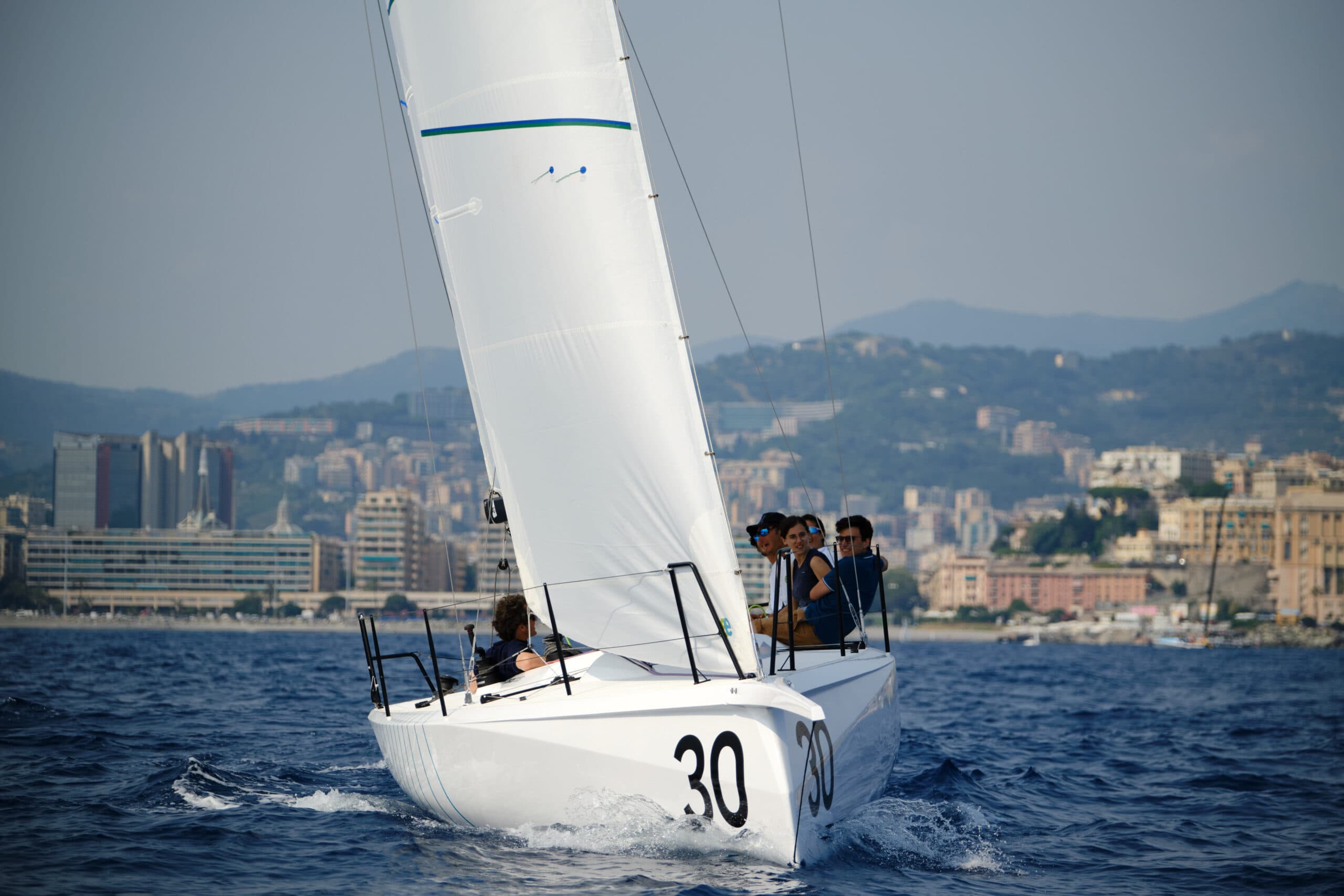
Northern Light Composites used them to build the ecoRacer30 — the first fully recyclable nine-metre sailing boat — targeting 90% recyclability by 2030.8
Nature's Original Composite
Wood is nature's composite: cellulose fibers providing tensile strength within a lignin matrix.18 It is renewable, and 1 m³ of wood stores over one tonne of CO₂ for its lifetime.19
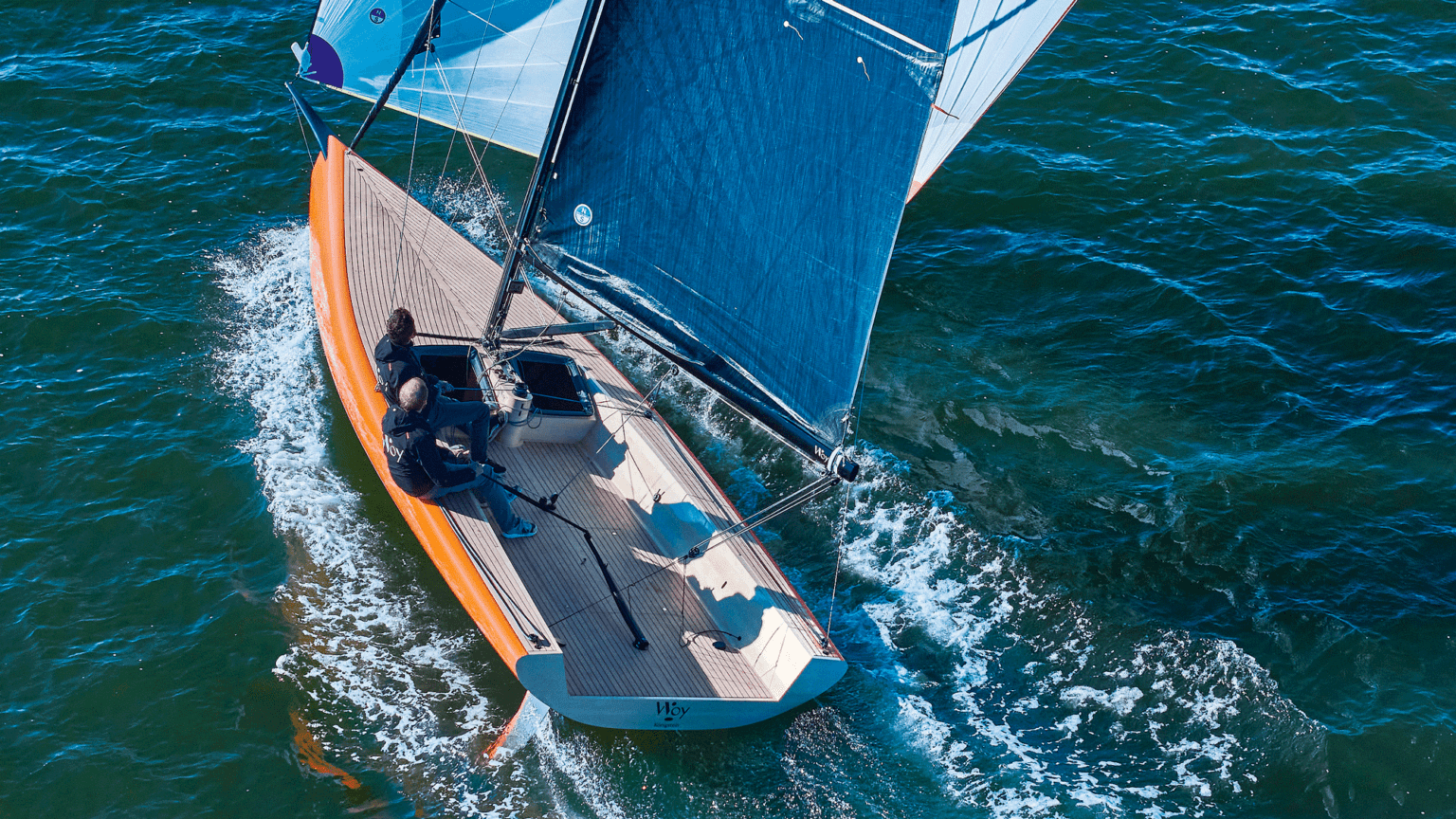
Modern tools — finite element analysis, CFD, parametric CAD — model wood's complex properties with precision that traditional boatbuilders never had. CNC machining translates digital designs into cut panels with millimetre accuracy.20
The SuMoth Challenge reinforces this: all natural biomaterials, including wood, cost zero SuMoth Dollars.9 Timber is a simulation-optimized, carbon-negative structural material that nature has refined for 400 million years.
The Competition
The SuMoth Challenge

Official competition platform
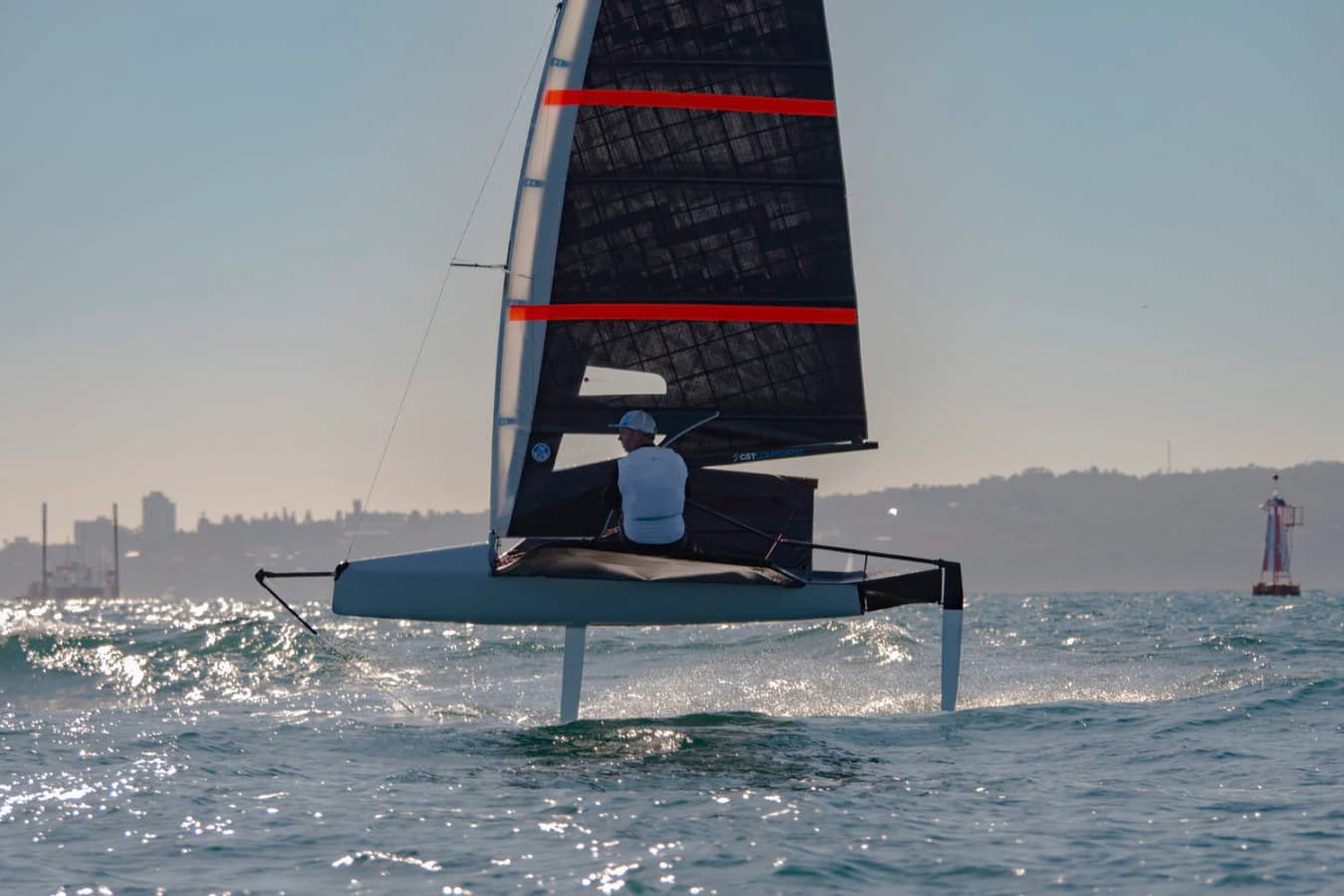
The Foiling SuMoth Challenge brings student teams together to design, build, and race Moth-class foiling sailboats using sustainable materials.9 If you have never seen a Moth sail: it is an eleven-foot dinghy that flies. Hydrofoils lift the entire boat and sailor above the water, eliminating hull drag and reaching extraordinary speeds.11
Teams must meet International Moth Class Association specifications while optimizing for sustainability. Every team receives 10,000 SuMoth Dollars, with all natural biomaterials costing zero SM$, and teams use MarineShift360 to quantify the environmental impact of every material choice.9 12 The competition takes place annually during Foiling Week on Lake Garda in Malcesine, Italy.
785
Students
15
Teams
7
Nations
For Students
Skills You Already Have
The skills this competition demands are the same ones taught in virtually every engineering program. Fluid dynamics maps to hydrofoil optimization through CFD.13 Materials science maps to natural fiber layup selection. Mechanical design, structural analysis, CAD, manufacturing — all core to a SuMoth build.
The team is not only for engineers. We need project managers, graphic designers, content creators, and business students for sponsorship and finance. Research consistently shows that design competitions develop the teamwork, communication, and problem-solving skills that employers rank as essential.14
Why This Matters
Traditional Build vs. Sustainable Build
| Metric | Traditional Composite | Sustainable (SuMoth-Style) |
|---|---|---|
| Primary Reinforcement | Carbon / glass fiber | Flax / natural fiber |
| CO₂ Footprint (production) | Baseline | Up to 60–85% lower |
| End-of-Life Recyclability | Near zero | Designed for circularity |
| Vibration Damping | Standard | Superior (natural fiber advantage) |
| Lifecycle Assessment | Rarely performed | Built into the design process |
Sources: Bcomp, Alliance Flax Linen Hemp, Nature Scientific Reports, NOAA
For sponsors, supporting aQuaFoil means brand visibility at an international competition, direct access to students with hands-on experience in sustainable composites and CFD, and alignment with a measurable sustainability mission. For students, this is a portfolio project no classroom can replicate — and candidates with demonstrated design competition experience are significantly more likely to receive job offers.16
Canada's marine economy generates $51 billion in annual GDP and supports nearly 446,000 jobs, with employment growing at 4.8% annually.17 The demand for engineers who understand sustainable materials is the direction the industry is moving.
Our Story
What We Are Building
aQuaFoil was founded at Queen's University in the fall of 2025 by two engineering students who share one thing above all else: a deep love of sailing.
Andrew Chisholm, a Schulich Leader studying Mechanical Engineering, is a WASZP Junior World Champion (2025) who has competed internationally across Europe and North America. He has coached youth sailing programs, interned with the NorthStar SailGP team in Germany, and brings years of experience optimizing boat setup and race strategy at the highest levels of the sport. Thomas Hung, an Engineering Physics student, represented Team Canada at the ISAF Youth Sailing World Championships in iQFOiL windsurfing (Brazil 2023, Italy 2024), has designed robotic end-effectors with the Canadian Space Agency, and serves as mechanical team director for Queen's autonomous surface vehicle team, aQuatonomous. He holds an NSERC undergraduate research grant and brings hands-on experience in composites manufacturing, CFD simulation, and structural analysis.
They met during Queen's orientation in September 2025 and knew immediately they wanted to build something together. The SuMoth Challenge gave them the perfect platform: an engineering problem demanding the intersection of high-performance sailing, sustainable materials, and computational design.
aQuaFoil is now a growing multidisciplinary team at Queen's, designing a competition-grade foiling Moth built from bio-composite and timber materials, optimized using CFD and FEA, and assessed for environmental impact through MarineShift360. The team's design philosophy is simple: sustainable performance, built to race. The goal is to represent Queen's University at the SuMoth Challenge 2027 on Lake Garda, Italy — and to prove that a boat built to disappear responsibly can still be built to win.
What's Next
The Road Ahead
Finalizing hull geometry and foil profiles through CFD simulation and physical testing
Fabricating the hull and structural components using bio-composite and timber materials at Queen’s University
On-water trials on Lake Ontario, iterating on control surfaces and ride height stability
Representing Queen’s University at the SuMoth Challenge 2027 in Malcesine, Italy
Expanding the team, building long-term sponsor partnerships, and establishing aQuaFoil as a continuing Queen’s program
The boats we build today will not end up in landfills. They are designed to be taken apart, reused, and returned to the earth. At aQuaFoil, we are not just building a faster boat — we are building proof that performance and sustainability belong together.
References
- NOAA Marine Debris Program. "Building a Fiberglass Boat Recycling Program." [1]
- PartsVu. "The Environmental Hazards of Fiberglass Boat Disposal." [2]
- MDPI Composites. "A Proposal for a Carbon Fibre-Manufacturing Life-Cycle Inventory." [3]
- NMMA. "The Recreational Boating Industry's Commitment to Conservation." [4]
- MDPI JMSE. "An Overview of Natural Fiber Composites for Marine Applications." [5]
- Alliance Flax Linen Hemp. "Natural Fibres at the Helm of Sustainable Boating." [6]
- Bcomp. "Bcomp's Materials Featured in the Foiling SuMoth Challenge." [7]
- World Sailing. "Innovation and Recyclability the Focus for NLComp." [8]
- SuMoth Challenge. Official Website. [9]
- 11th Hour Racing. "SuMoth Challenge 101." [10]
- Wikipedia. "Moth (dinghy)." [11]
- MarineShift360. Official Website. [12]
- OnePetro / JST. "Dynamic Stability Analysis of a Hydrofoiling Sailing Boat Using CFD." [13]
- Gadola & Chindamo (2019). "Experiential Learning in Engineering Education." [14]
- Tembrevilla (2024). "Experiential Learning in Engineering Education: A Systematic Review." [15]
- Siemens. "Why Engineering Student Competitions Are Worth It." [16]
- DFO Canada. "Marine Sectors in Canada." [17]
- Stephens Waring. "The Complexity of Sustainable Boat Building." [18]
- METSTRADE. "Can Wood Return as Sustainable Boat Construction Material?" [19]
- OnePetro / JST. "CNC Enabled Wood/Metal Composite Construction of Sailing Yachts." [20]